At a Pakistani wedding, the couple does not only pose for a photographer. They sit on a decorated stage while relatives, friends and neighbors queue up for a photograph, a handshake, a hug and a few words of congratulations. Every guest expects a photo with the couple. Every parent expects a formal portrait with their child. And one photographer is expected to capture all of it in a few hours, in a crowded hall, with children running and music playing.
This guide explains how family photos and stage photography at Pakistani weddings in Houston actually work, how to organize them so that nobody is forgotten and the couple is not exhausted, and how to brief your photographer. We are ZF Media Production, a Pakistani-owned studio in West Houston with more than 17 years of experience at weddings in Pakistan, Dubai and Texas, so large-family photography is something we do every week.
Why stage photos are a Pakistani wedding tradition of their own
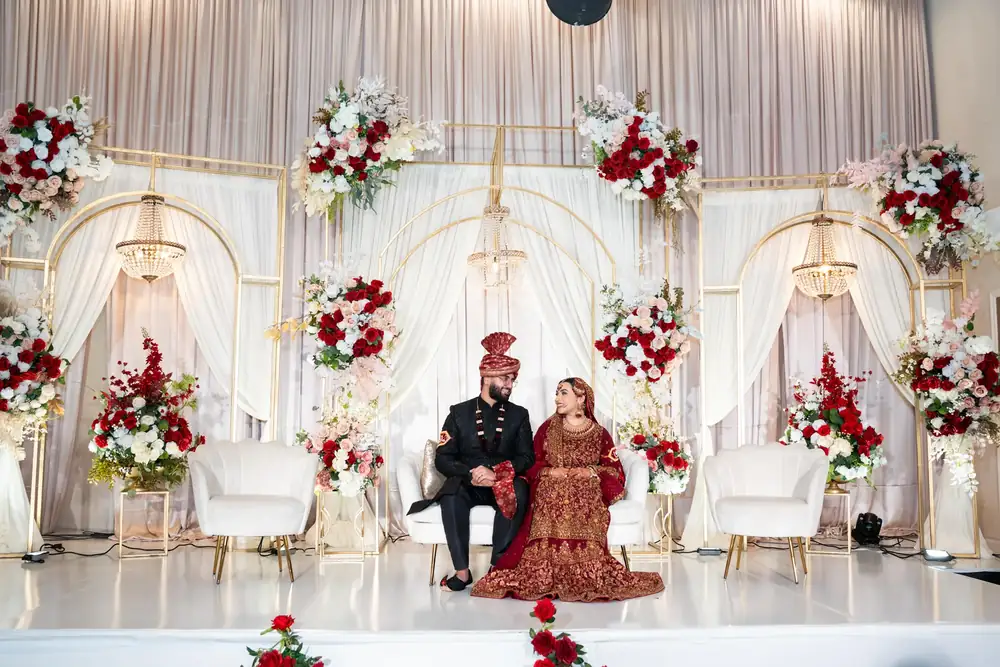
In many Western weddings, the couple is photographed away from the guests and the reception continues without them. At Pakistani weddings, the couple is usually seated on the stage for much of the evening, and guests come to them. This makes the stage the center of the event, and the stage photography one of the main jobs of the day.
Two things make it different from other photography:
- Volume. A wedding with a few hundred guests can involve dozens of separate stage photos, each with a different combination of people.
- Time pressure. Guests arrive in waves, children get tired, and the couple cannot sit for hours without a break.
The solution is not more photographers. The solution is a plan.
Step 1: Make a family group list before the wedding
The best tool is a one-page list of groupings, in the order you want them photographed. Here is a sample list that works for most Pakistani families, from most important to least:
- Bride and groom alone, on the stage
- Couple with the bride’s parents
- Couple with the groom’s parents
- Couple with both sets of parents together
- Couple with the bride’s grandparents
- Couple with the groom’s grandparents
- Couple with the bride’s siblings and their spouses and children
- Couple with the groom’s siblings and their spouses and children
- Couple with the bride’s uncles and aunts, one group per family branch
- Couple with the groom’s uncles and aunts, one group per family branch
- Couple with cousins (each side, then both together)
- Couple with the bride’s closest friends
- Couple with the groom’s closest friends
- Couple with colleagues, neighbors and community members
Print the list or share it with the photographer, and name one trusted relative on each side to call each group by name. Without a caller, the photographer ends up searching a crowded room for someone who is eating.
Step 2: Photograph elders first
This is the most important rule of the whole evening. Elders have the least patience for standing, the least energy late at night, and the most emotional value in the photographs. Photograph grandparents and senior relatives first, even if the hall is not yet full. Then move to parents, then siblings, then everyone else.
If an elderly relative cannot climb onto the stage, bring the couple down to a chair near the stage. A photograph in a living room chair is better than no photograph at all.
Step 3: Decide between a queue and a fixed block of time
There are two ways to organize stage photography, and both work if chosen deliberately.
Option A: The open queue
Guests come up in small groups as they please, usually after dinner or during the music. The advantages are that it is relaxed and everyone gets a photo. The disadvantage is that it can run for hours, and the couple may be stuck on the stage while the dancing continues without them.
Option B: A fixed photo block
You set aside 45 to 60 minutes for stage photos. The MC announces it, and a family member helps call groups. After the block, the couple joins the party. The advantage is that the schedule stays under control. The disadvantage is that some guests will miss the block, so allow a short second block later in the evening.
A simple calculation helps. If each group takes 90 seconds, 30 groups take 45 minutes. At 60 seconds, 30 groups take 30 minutes. This is why we recommend a written list rather than an unplanned queue.
Step 4: Set up the stage for photographs
Many stage photographs are weakened by the stage itself. Check these before guests arrive:
- Lighting. A stage lit only by colored decorative lights will give strange skin tones. Ask the venue or decorator for a clean, warm white light on the couple and the center of the stage.
- Background. A clean, decorated backdrop, such as flowers, drapes or a simple frame, photographs better than a busy wall.
- Seating. Two chairs or a sofa for the couple, and room on both sides for family to stand without hiding the couple.
- Steps. Make sure the stage steps are safe in long dresses and heels, and that an elderly relative can climb them.
- Flower arrangements. Tall arrangements on the sides can block the photographer’s view of group photos. Ask the decorator to keep the center low and open.
A decorator who finishes the stage early gives the photographer time to photograph the empty stage before the guests arrive. This is the best chance to capture the decor you paid for. Our guide to Houston wedding venues covers what to check at the venue itself.
Step 5: Be realistic about children
Children are the hardest part of family photographs, and also the most joyful. A few simple rules help:
- Photograph young children early, before they are tired or hungry.
- Seat the youngest at the front, either on a parent’s lap or standing near the couple.
- Let a parent hold the child’s favorite toy or snack just out of frame.
- Take the photo quickly. Three frames in ten seconds will usually include one good one.
Gender-separated halls and mixed events
Many Pakistani weddings in Houston have separate areas for men and women, or a mixed hall with different expectations for photographs. The plan should be clear before the day:
- Decide which events or sections are photographed, and who may be photographed.
- Where there are two areas, decide how the photographer will move between them and when.
- For family groups that include both men and women, agree on a time when everyone will be together, or use separate photographs for each group.
We plan this with the family in advance, in English, Urdu, Hindi or Punjabi, so there are no surprises. Our Nikah and Walima page explains our approach to gender-separated events in more detail.
Candid photos still matter
Stage and family formals are only half of what a photographer does. The other half is candid coverage: the aunt who has not seen her nephew in ten years, the children playing under the tables, the elders talking in a corner, the cousins taking selfies. A good photographer moves between formal groups and candid moments, never staying on the stage all night. If you plan stage photos, ask how the photographer will cover the rest of the hall during that time. Our South Asian wedding shot list explains how to balance the two.
Video on the stage
For a wedding film, the stage is also a source of the most emotional footage: the greetings, the dua from elders, the quiet words of congratulation. A videographer will usually place a fixed camera on the stage to record the greetings, and use a second camera to follow the couple. Plan to have the music lowered during the stage photos so the voices can be recorded. If the wedding is being streamed to relatives abroad, a separate camera can show the stage to the guests who cannot attend. See our live streaming page for details, and our wedding videography cost guide for how cameras and hours affect pricing.
What to tell your photographer
- The size of the guest list and the approximate number of family groups
- The names of the elders who must be photographed
- The relatives who will call the groups, with their phone numbers
- Whether you want an open queue or a fixed photo block, and when it will start
- Any family tensions or sensitivities that the photographer should know
- The venue’s stage dimensions, lighting and rules
The more your photographer knows, the less they need to ask during the event, and the more time they have for the unplanned moments. Our guide on how to choose a wedding photographer in Houston includes questions to ask any photographer about large family weddings.
Cost and coverage
Large family weddings need longer coverage so the stage photos do not eat into the rest of the evening. Wedding and event photography starts from $599; wedding films range from $1,500 to $4,000+ depending on days, hours and edit length. For a full explanation of the options, visit our Pakistani wedding photography page. We also describe how Pakistani wedding events connect in our Pakistani wedding events guide, which helps decide how many events to cover.
Frequently asked questions
How many stage photos should we expect?
It depends on the guest list and family size. Many weddings have somewhere between 20 and 60 stage groups. Plan for 60 to 90 seconds per group.
Can we skip stage photos and only do candids?
Yes, but most families regret it. A written list with a fixed block of time is usually the best compromise.
What if an elder cannot climb the stage?
Bring the couple down to a chair near the stage, or photograph the elder at a table in good light. The photograph is what matters, not the location.
How do we make sure nobody is forgotten?
Make a list, assign two callers (one for each side), and give the list to your photographer a week before the wedding. We can also suggest a second photo block later in the evening for guests who arrive late.
How soon will we receive family photos?
For weddings, the online gallery is typically ready in 2 to 4 weeks, and the highlight film in 1 to 2 weeks. If you need specific family photos earlier for a relative traveling abroad, tell us.
Planning a Pakistani wedding in Houston? Tell us your date and guest count, or call or WhatsApp 832-400-4333. Our studio is at 3505 S Dairy Ashford Rd, Suite 120, Houston, open Monday to Saturday, 9 AM to 6:30 PM.